
The Copagandists 6 | Jack Webb Pt 4: Webb's Early Career
Before "Dragnet": Webb's early life, military career, and post-war radio work... also we'll talk a little bit about the history of the LAPD

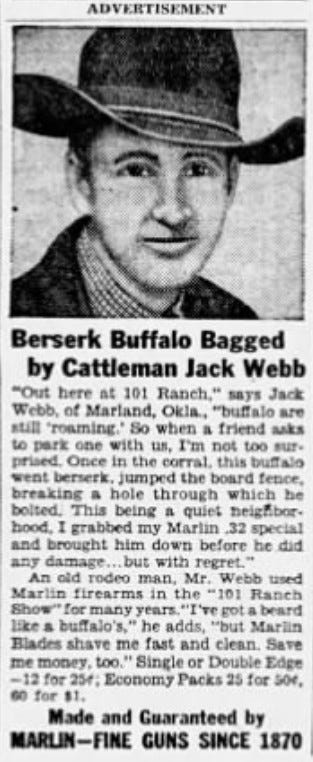
With all the context of TV history, show production, genre convention, and political controversy under our belt, let’s turn our attention to the activities of a single individual who walked through these spaces: Jack Randolph Webb (not to be confused with the Jack Webb of Marland, Oklahoma, renowned for bagging a berserk buffalo in early 1949...).
Jack Webb’s Early Career
Webb was born on April 2, 1920 in Santa Monica, California. Little is known about his parents, although it’s certain that his father did not stick around to raise his son. Webb’s mother, penniless, moved to Los Angeles and settled in a poor part of town. With his mother busy looking for work, and also having trouble with alcohol, Webb’s rearing was left largely to his grandmother. While he spent much of his childhood scrounging through trash, his grandmother fostered in him a love of reading, acting, and art – interests that his mother also encouraged when she could. Early on he discovered a particular interest in jazz music and Hollywood films, with The Big Parade and Mr. Deeds Goes to Town being two of the earliest movies he recalled seeing.1
By high school Webb had taken to art, theater, and radio, listening constantly to the mystery and crime shows that beamed across mid-1930s California. Because it was the Depression, Webb had to forgo attending college in favor of finding work. There was bread to win. This also forced him to put acting off to the side, which he would not return to until the early 1940s, when he engaged in some theater work.
When WW2 began in the US, Webb received the draft classification 3-A, deferral due to dependent obligations (his mother and grandmother were in poor health). Nevertheless, he entered the Army Air Corps. While a cadet, he wrote and drew for a local magazine and produced some theater. His final exam required him to pilot a BT-13A trainer, which he failed to do.
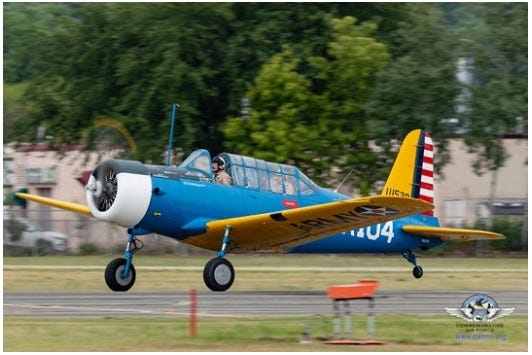
Having washed out of flight school, Webb manned a typewriter at Laughlin Air Force Base in Texas. After two year’s employment (Nov 1942 - Jan 1945), he applied for and received a hardship discharge in order to care for his ailing mother and grandmother.2
Given that one of the overarching concerns of this series is the process of historical research, the use or misuse of the past, it’s interesting to note that once Webb achieved public notoriety, his military career would become the subject of some mythmaking. A March 1949 profile, for instance, erroneously stated: “[Webb was sent to Texas] to learn to fly B-26s and stayed there teaching others.”3 Reporting on Webb’s birthday in 1956, the AP mentioned that while in the Army Air Force, Webb “piloted B26 bombers.”4
These myths persisted. Webb died in 1982, but even in the early 1990s, during a revival of Dragnet and consequent renewal of interest in Webb himself, one newspaper incorrectly told an inquiring reader that Webb “serv[ed] as a bomber pilot in World War II...”5 One wonders where these myths began – had Webb lied or were there other sources used by these early reports?
The authorized biography of Webb, completed with the assistance of Webb’s family, does not indicate where the falsehoods might have originated but does try to exonerate Webb himself: “Some misinformed newspapers and magazines printed after Jack achieved celebrity status that he had piloted bombers and had downed enemy aircraft during the war. Jack, always a patriot, was particularly hurt when one magazine accused him of faking his war record, which he would never do.”6
Webb did, in point of fact, sometimes fudge his past. A 1954 Time magazine profile, which set the record straight regarding Webb’s martial prowess, very gently chided him for fibbing: “He soloed but was washed out during primary training (although he sometimes claims, in moments of imaginative reminiscence, to have flown B-26 bombers)...”7
The authorized biography, although it does not admit that Webb lied, does give us an indication of why he might have done so, quoting Webb as saying:
[My time in the Army was] one of the few barren periods of my life. I went in with a dream. I came out with a blank page. Worst of all, I failed to measure up to my boyhood ‘paper heroes’.8
Considering Webb’s later reputation as a storyteller who valued authenticity above all else, his erratic relationship to the truth of his own life, while understandable, is certainly troubling. This should remind us that no one is above editing the narrative of their own existence – or doing the same to the rest of the world when reality does not live up to imagination.
At any rate, after a few months in LA caring for his family, Webb moved to San Francisco to start a career in radio. A bit of luck got him hired at a local station, KGO (part of the ABC network), where he soon began covering news events from his recording booth, like VJ Day celebrations and the Marine Corps assault on Alcatraz Prison (May, 1946). He also met writer Jim Moser, with whom he would collaborate frequently in the future.
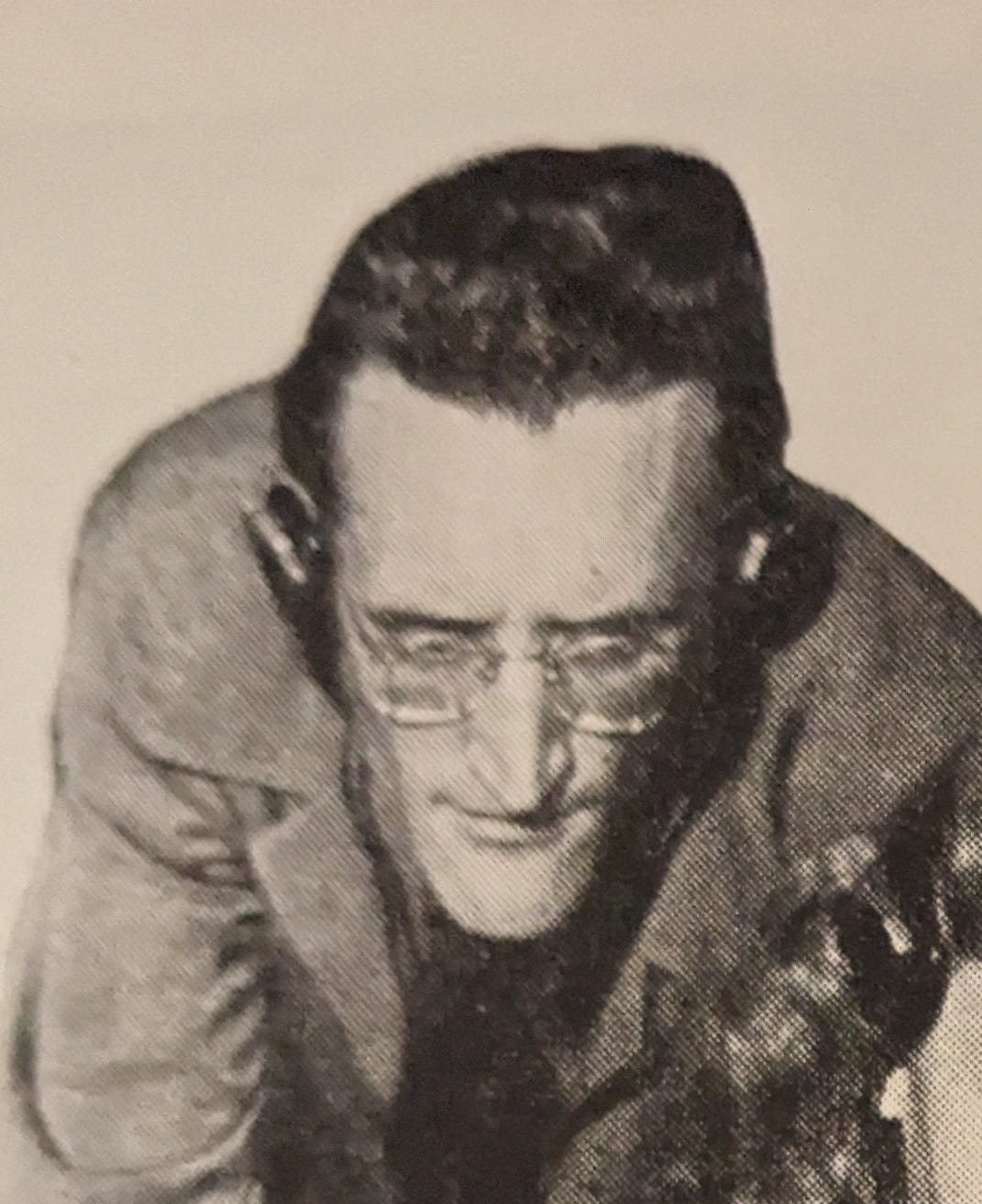
Webb’s first regular show was a news program called One Out of Seven, created by Moser. It was a current events show where Webb would impersonate celebrities and politicians as he read through the week’s significant events.9 These performances included people from other races, so it did suffer from stereotyping. Webb’s political slant was more liberal at this time, however, which did make his editorializing quite critical of racial bigotry, notably in the episode covering Mississippi’s notoriously racist senator Theodore G Bilbo.10
Consider this snippet from the Bilbo episode, where Webb frames his reporting on the senator in remarkably sarcastic terms:
Theodore Gilmore Bilbo is an honorable man. As a member of the United States Senate he is looked upon as such by the eyes of the law. Perhaps he is looked upon as such by many or most of his constituents. Though his voice occasionally grate [sic] upon the nerves, and his views often confound the innocent, the fact remains, as a member of the Senate of the United States, Theodore Gilmore Bilbo is an honorable man. And we do not intend to prove otherwise. We merely wish to cite a few samples of his handiwork and perhaps a supplementary side glance or two just for the sake of contrast.11
While making this show, Webb soon met another staff writer at KGO, Richard Breen, and together they created the private-eye show Pat Novak for Hire.
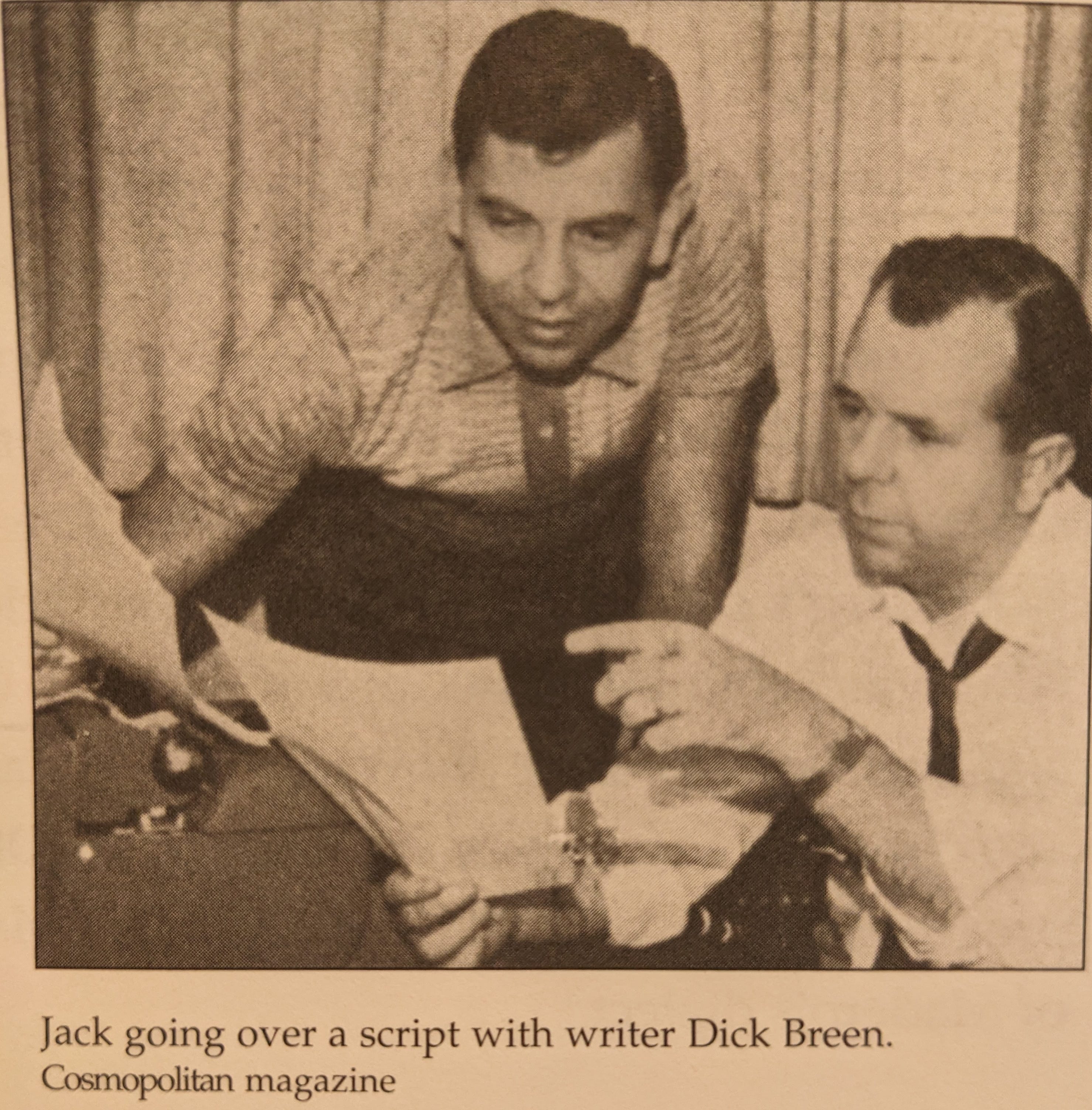
At Breen’s urging, Webb modulated his voice to downplay his delivery, advice that Webb would take to his grave. The show aired for nearly thirty weeks in 1946 and enjoyed both ratings and critical success. This was the show that really put Webb on the map, radio-wise.
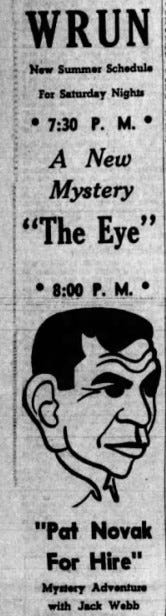
Radio scholar J Fred MacDonald would subsequently describe the character of Pat Novak as one that, “through the overextended similes...emerged as a powerful but unstable hero with emotional traits bordering on psychosis.”12 This character was pure literary invention, iterating on genre rather than pulling from lived experience. Yet it proved popular, with audiences drawn to Webb’s hard-boiled, albeit stereotyped, dialogue. For example:
The street was as deserted as a warm bottle of beer...a car started up down the street and the old man couldn’t have made it with a pocket full of aces...I caught a glimpse of the license plate in a dull, surprised way, the way you grab a feather out of an angel’s wing.13
In addition to the colorful dialogue, Pat Novak also engaged in the hard-boiled commonplace of pitting its detective hero against an antagonistic police department, personified here by inspector Hellman, once described on the show as being so mean that, “he wouldn’t give his wife an aspirin if she had concussion of the brain.”14
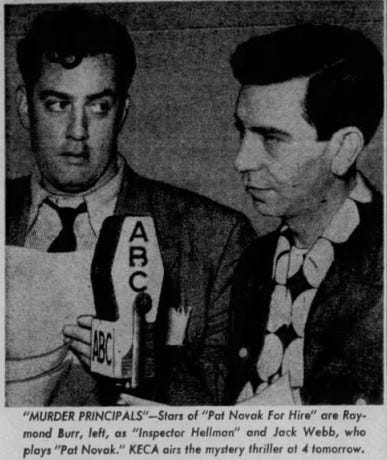
By the end of the year, however, Breen and Webb would have a falling out, with both departing KGO for Hollywood. This brought Pat Novak to a temporary end. While in Hollywood, Webb would land a number of bit and small parts, most importantly for our story a role in the 1948 semi-documentary crime drama He Walked By Night.
Genesis of Dragnet
He Walked by Night is notable for several things: the use of the term dragnet; advising the audience that its case was real and that Only the names are changed to protect the innocent; and the use of the Los Angeles Central Hall building as a primary location, all of which would find their way into Webb’s future work.
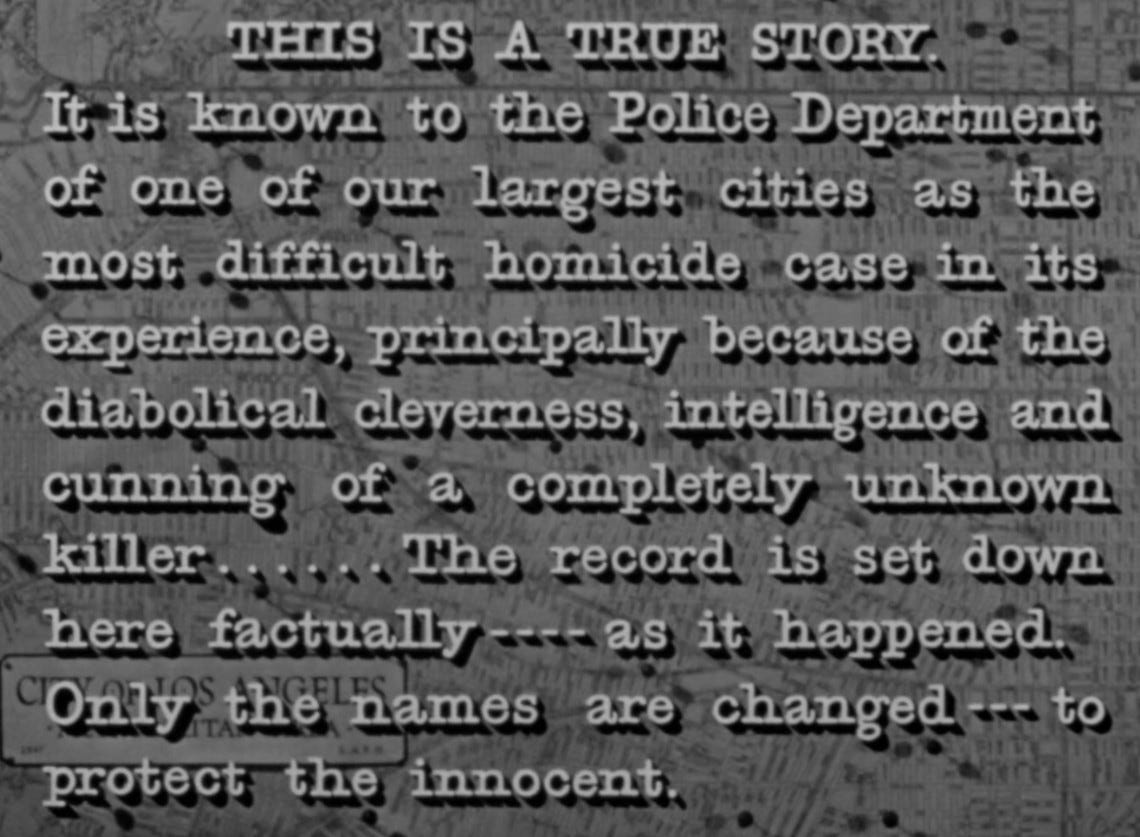
While on set, Webb began chatting with LAPD sergeant Marty Wynn, assigned as technical advisor to the film.
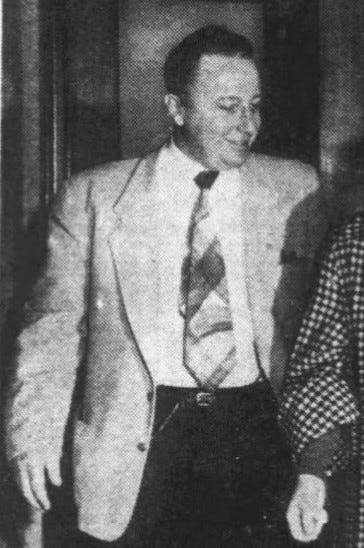
Chatting with Webb, officer Wynn lamented the current state of crime fiction because of its unreality: “…they’re all jazzed up and the detectives are all supermen, and they do it with mirrors. Real cops don’t work like that.” He asked his coworker why Hollywood didn’t make something better – why didn’t Webb?15 Heck, if Webb were interested, Wynn actually had access to the LAPD’s case files, which were in the public domain. Webb could use them in the creation of a more realistic radio show!16
Initially Webb was uninterested in the idea. The airwaves were already inundated with crime shows, even ones that claimed to be realistic. He told Wynn: “There are already a lot of similar shows – True Detective Mysteries, Gangbusters, and so on.” Webb added that the melodrama was what sold, “That’s why the fiction shows have such high ratings.”17
Moreover, Webb was busy with other radio projects. He played Jeff Regan, Investigator for CBS in the summer of 1948 and then returned to Pat Novak in February 1949. Although it had been off the air since 1947, listener interest had prompted the network to bring it back. According to radio critic Bill Bird, “there has been a fairly steady stream of requests pouring into ABC’s Hollywood headquarters requesting its return.” Bird, for his part, called the returning show “smartly-paced” and “one of the few programs of the [whodunit] type that offers a suggestion of originality, which applies both to treatment and the principal characters involved.”18
Perhaps it was the very artifice of Pat Novak that left Webb open to the idea of a more realistic show, for despite his initially negative answer to Wynn, Webb found it hard to shake the cop’s idea. As he ruminated, the idea crystalized in Webb’s mind: to tell stories about regular, professional, routine police officers, without the melodrama, artifice, and sadistic violence so common in crime fiction at the time. Webb later explained: “Our idea is to let the listener eavesdrop on the police detective as he goes through his daily routine and to hear him as he is – an average workingman with an above average amount of patience.”19
This police detective was to be a regular Joe, not a super sleuth. As Webb put it:
I wanted him to be an honest, decent, home-loving guy – the image of 50,000 real peace officers who do their work without the help of beautiful, mysterious blondes, hefty swigs from an ever-present bottle and handy automatics thrust into their belts or hidden in their socks.20
Six months after their chat on He Walked By Night, Webb met officer Wynn again, this time at the Elysian Park Police Academy. He asked to ride along with Wynn and his partner, which began a long process of research as Webb hoovered up every detail of police work.21
As this research progressed, Webb brought the show to life with the help of producer William Rousseau, with whom he had worked on Pat Novak for Hire.
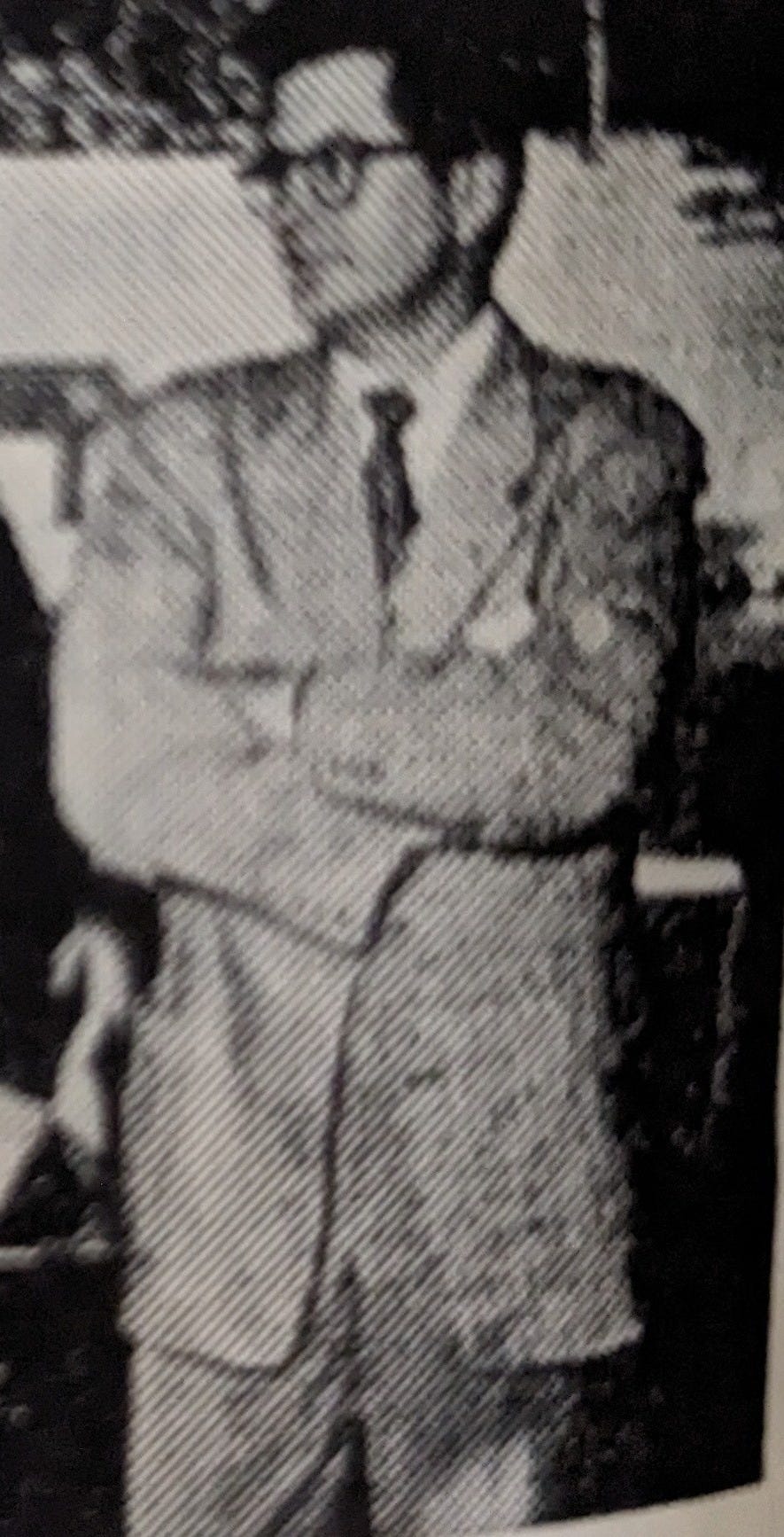
Together, they approached Webb’s old collaborator Jim Moser as the show’s first writer. In addition to his radio work, Moser had done considerable journalistic work, writing the crime beat for the San Francisco Examiner, then traveling to Shanghai to write for the North China Daily News, then the Sydney Morning Herald before working for the US Merchant Marine during World War Two. After the war he worked for the Associated Press and then went into radio. Webb, Moser, and Wynn put together a rough script to shop around the radio networks.22
The idea of doing a more “realistic” show did not immediately set the broadcasting world ablaze. Webb’s agent, for one, insisted that the very premise was bunk: “You need a Sam Spade character,” he told Webb at the time. He further warned that doing “fact-based” stories opened Webb up to legal liability: “You’d get sued for libel on every program.” There was some interest among broadcasters themselves. Radio juggernaut CBS liked the idea, but not so much that it was willing to finance a pilot. Maybe they’d broadcast something if Webb funded the pilot himself, but they wouldn’t take any risk on the idea. NBC’s Western Division program manager Homer Canfield was more forthcoming.23 In 1949 he got NBC to agree to finance a trial run of one month’s worth of episodes. If it proved successful, i.e. attracted a corporate sponsor, then it could continue to air on NBC’s schedule (with the sponsor bankrolling additional episodes).24
Before the show could go into production Webb wanted to get the cooperation of the LAPD. Perhaps he could have accessed their case files without official assistance, but it would certainly make the process easier if they cooperated. Unfortunately, the department had declined to support a number of shows on account of their sensationalism, so getting official sanction wasn’t a sure thing. Given the controversy surrounding the LAPD at this time, their reticence to offer cooperation to outsiders they might not be able to control was understandable. Now would be a good time to familiarize ourselves with the LAPD of the late 1940s...
The LAPD
The department was sorely in need of reform. In the 1920s and 1930s the LAPD engaged in blatantly political, often illegal activities, including political graft, the physical abuse of suspects, and the surveilling of political undesirables (e.g. communists and union activists). In 1938, officers from the Special Intelligence Section had grown so jealous of their power as to plant a car bomb in the vehicle of a police reform group’s investigator.25
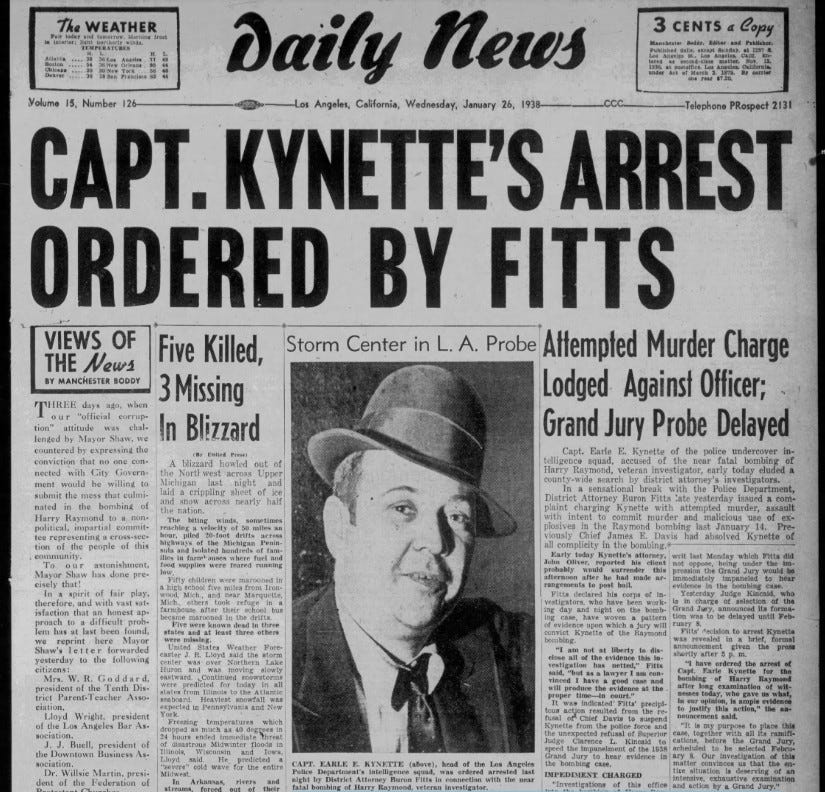
(The court case that resulted from this terror attack, People v. Kynette 15 Cal.2d 731, can be read here.)
As minorities moved into the city in the 1930s and 1940s, notably Jewish migrants fleeing Europe, migrant workers from other states, Mexicans, and African Americans coming up from the South, the police increasingly engaged in targeted and racist policing. In 1936, LAPD chief Davis sent some 126 officers to state highways to turn back out-of-state workers traveling to California in search of work, the so-called “Bum Blockade.” The racism came to a head in 1943 during the Zoot Suit riots, when police stood by as soldiers and sailors attacked Mexican youths, prompting street violence that lasted for days. Officers also maintained de facto racial segregation in public spaces, for instance separating whites from blacks, Mexicans, and Filipinos so as to prevent interracial dancing at jazz clubs and harassing minority youths all across the jazz scene.26
During these years, some officers, like rising star William H Parker, championed efforts at professionalization, especially civil service protections for police (to prevent the influence of graft) and better discipline (to root out the influence of vice). Yet the leadership at the top was either disinterested or else only partially successful in turning reformist rhetoric into concrete action.
When Dragnet came on the scene in the first half of 1949, chief Clemence Horrall led the LAPD, in office since 1941. He’d overseen the department through the Zoot Suit riots, the controversy surrounding the Black Dahlia murder in 1947, and a number of scandals, one of which finally led to his resignation right as Dragnet went to air.
This was the Brenda Allen Scandal, named after the woman who led a prostitution ring of more than one hundred women and whose connections (romantic and professional) to the LAPD granted her protection (she paid the cops $50 per girl to keep them off her case). When one vice sergeant wiretapped Allen and discovered incriminating phone calls between her and another vice sergeant, he immediately informed chief Horrall. Allen was sent to prison and Horrall thought the matter closed.
But Brenda Allen, understandably angry at being double-crossed by the very cops she had been paying off, decided to use publicity as a weapon, spilling the beans about the protection money, her personal relationship with a vice sergeant, and accusing the other vice cop of being on the take as well.27
This garnered enough press attention that a grand jury was formed to weigh in on the matter. This jury indicted chief Horrall and a number of other high ranking officers, including the head of the gangster squad and the head of the Red Squad – all on charges of perjury and extortion. All the officers retired in disgrace (though they were later exonerated).28
After an interim chief led the department through the remainder of 1949, William H Parker became chief of the LAPD in 1950 and with this appointment came a revolution in US policing.
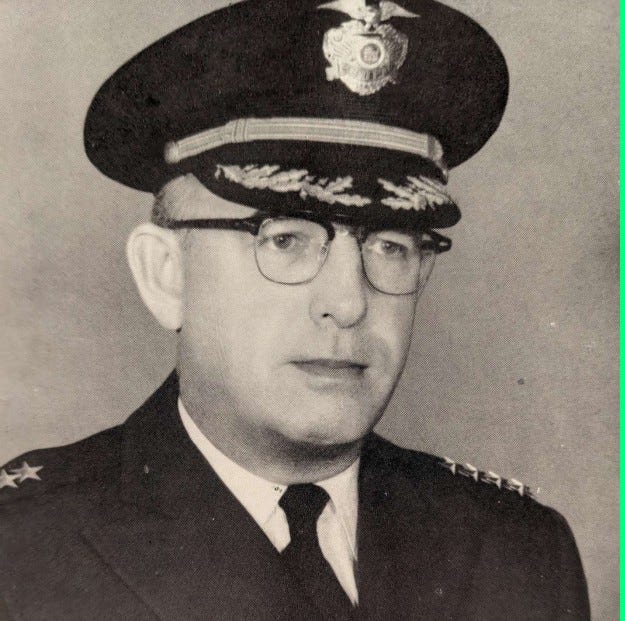
The term “professionalization” had been around for decades by this point, and plenty of cops and other would-be reformers existed before and contemporaneously with Parker, but, as scholar Alisa Sarah Kramer summarizes, it was Parker that managed to be “the first chief of a big city department in the postwar years to establish rigorous standards for hiring, training and promotion, and to significantly reduce corruption and incompetence.”29
Regardless of whether Parker’s reforms would ultimately bring “good” policing to Los Angeles, the very fact that he wanted to upend an existing status quo meant that he quickly attracted political enemies. Three things, however, allowed him to maintain his authority for the next sixteen years:
the decentralized structure of the LA government;
the lifetime tenure of the office of chief of police;
and his proximity to Hollywood.
Indeed, a large part of Parker’s political acumen boiled down to his uncanny ability to use the media to his advantage. For it was through the media that he got the public on his side, as he brought to bear both print media and broadcasting to sully his opponents and augment his own image and that of his police force.30
So, while it was actually (disgraced) chief Horrall who initially approved of Dragnet, it would be chief Parker who, over the course of the 1950s, would harness this new show in a coordinated effort to boost the public stature of his sullied slice of the Los Angeles government. In so doing, he would build upon the precedents set by the publicity-minded cops of the 1930s, his chief innovation being the use of a brand new medium: television. But before he could make use of television, he would have to see how Dragnet faired on radio. It is to those early radio broadcasts that we’ll turn next time...
Daniel Moyer and Eugene Alvarez, Just the Facts, Ma’am: The Authorized Biography of Jack Webb, Washington, DC: Seven Locks Press, 2001, 7
Daniel Moyer and Eugene Alvarez, Just the Facts, Ma’am: The Authorized Biography of Jack Webb, Washington, DC: Seven Locks Press, 2001, 37-39
Walt Taliaferro, “Pat Novak doing good job back on the air again,” Los Angeles Daily News, March 14, 1949
AP News features, “Today’s Birthday,” The World-News, April 2, 1956
Bettelou Peterson, “Jack Webb was a bomber pilot,” The Buffalo News, June 27, 1993
Daniel Moyer and Eugene Alvarez, Just the Facts, Ma’am: The Authorized Biography of Jack Webb, Washington, DC: Seven Locks Press, 2001, 39
“Jack, Be Nimble!,” Time, March 15, 1954, Vol. LXIII No. 11, https://time.com/archive/6794861/jack-be-nimble/
Daniel Moyer and Eugene Alvarez, Just the Facts, Ma’am: The Authorized Biography of Jack Webb, Washington, DC: Seven Locks Press, 2001, 39
Dwight Newton, “Day and Night with Radio and Television,” The San Francisco Examiner, November 21, 1949
Daniel Moyer and Eugene Alvarez, Just the Facts, Ma’am: The Authorized Biography of Jack Webb, Washington, DC: Seven Locks Press, 2001, 44
“One Out Of Seven: Senator Theodore Bilbo,” Old Time Radio Downloads, accessed 3/6/2025, https://www.oldtimeradiodownloads.com/historical/one-out-of-seven/senator-theodore-bilbo-1946-02-06
J Fred MacDonald, Don’t Touch That Dial! Radio Programming in American Life from 1920 to 1960, Chicago: Nelson-Hall, 1979, 209
Daniel Moyer and Eugene Alvarez, Just the Facts, Ma’am: The Authorized Biography of Jack Webb, Washington, DC: Seven Locks Press, 2001, 53
J Fred MacDonald, Don’t Touch That Dial! Radio Programming in American Life from 1920 to 1960, Chicago: Nelson-Hall, 1979, 209
Allen Glover, TV Noir: Dark Drama on the Small Screen, New York: Abrams, 2019, 71-72; Claudia Calhoun, Only the Names Have Been Changed: Dragnet, the Police Procedural, and Postwar Culture, Austin, TX: University of Texas Press, 2022, 51
Daniel Moyer and Eugene Alvarez, Just the Facts, Ma’am: The Authorized Biography of Jack Webb, Washington, DC: Seven Locks Press, 2001, 56
Claudia Calhoun, Only the Names Have Been Changed: Dragnet, the Police Procedural, and Postwar Culture, Austin, TX: University of Texas Press, 2022, 51
Bill Bird, “Radio On Review,” Pasadena Independent, February 13, 1949
Allen Glover, TV Noir: Dark Drama on the Small Screen, New York: Abrams, 2019, 72
Claudia Calhoun, Only the Names Have Been Changed: Dragnet, the Police Procedural, and Postwar Culture, Austin, TX: University of Texas Press, 2022, 52
Daniel Moyer and Eugene Alvarez, Just the Facts, Ma’am: The Authorized Biography of Jack Webb, Washington, DC: Seven Locks Press, 2001, 56
Joe Beck, “Dragnet,” True Detective Magazine, March 25, 1950, 72
Zuma Palmer, “Idea for ‘Dragnet’ Born on Movie Set,” Los Angeles Evening Citizen News, March 8, 1950
Claudia Calhoun, Only the Names Have Been Changed: Dragnet, the Police Procedural, and Postwar Culture, Austin, TX: University of Texas Press, 2022, 53
Alisa Sarah Kramer, William H. Parker and the Thin Blue Line: Politics, Public Relations and Policing in Postwar Los Angeles, Washington, DC: American University PhD dissertation, 2007, 29
Alisa Sarah Kramer, William H. Parker and the Thin Blue Line: Politics, Public Relations and Policing in Postwar Los Angeles, Washington, DC: American University PhD dissertation, 2007, 32
“Brenda’s Revenge,” Time, July 11, 1949, https://time.com/archive/6791257/california-brendas-revenge/
Alisa Sarah Kramer, William H. Parker and the Thin Blue Line: Politics, Public Relations and Policing in Postwar Los Angeles, Washington, DC: American University PhD dissertation, 2007, 42
Alisa Sarah Kramer, William H. Parker and the Thin Blue Line: Politics, Public Relations and Policing in Postwar Los Angeles, Washington, DC: American University PhD dissertation, 2007, 11
Alisa Sarah Kramer, William H. Parker and the Thin Blue Line: Politics, Public Relations and Policing in Postwar Los Angeles, Washington, DC: American University PhD dissertation, 2007, 18